
Buying sense: the checks a cheap listing must pass
Specification menus, seller signals, agent paperwork and catalog sites: the checks that decide whether a cheap listing stays cheap.
Spec menus, size-chart images and price spreads
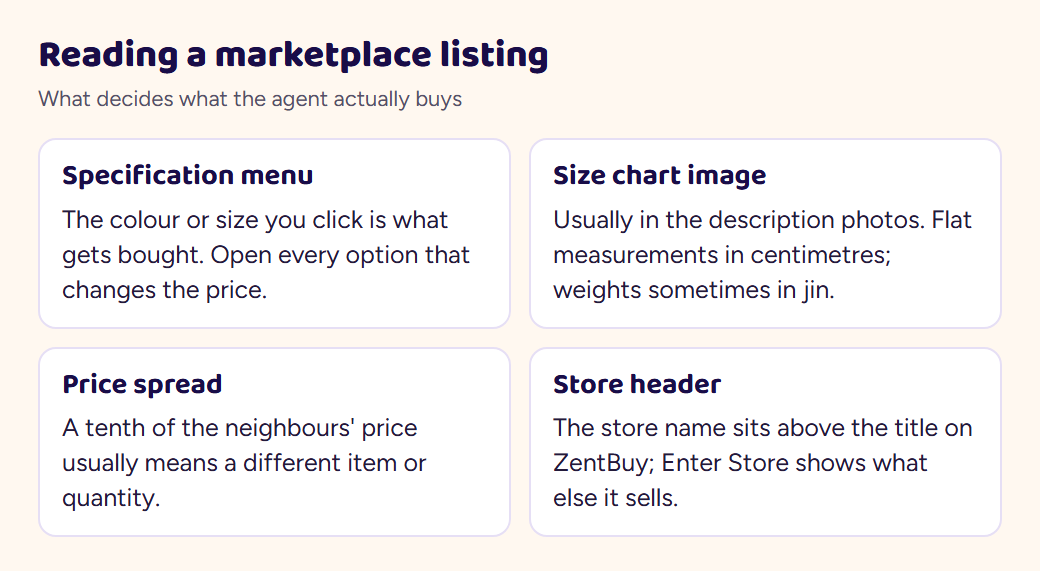
How to pick a product that survives the warehouse photos comes down to reading the listing the way the seller wrote it, not the way the translation renders it. Start with the specification menu, because that is what the agent buys: the colour you click, the size you click, nothing else. Sellers often stuff that menu with other things: a gift box offered as if it were a size, colour names that are only numbers, a cheaper first option that is a different item altogether. Open every option that changes the price and read what else changes with it.
Then look for the size chart in the seller's own photos, usually a long image in the description. Chinese charts give flat measurements in centimetres, often chest width laid flat rather than around the body, and they sometimes add a weight range in jin (half a kilo each). Measure a garment you own the same way. Finally, check the price spread: a listing at a tenth of its neighbours is either a different product or a different quantity.
Seller signals worth more than the star rating
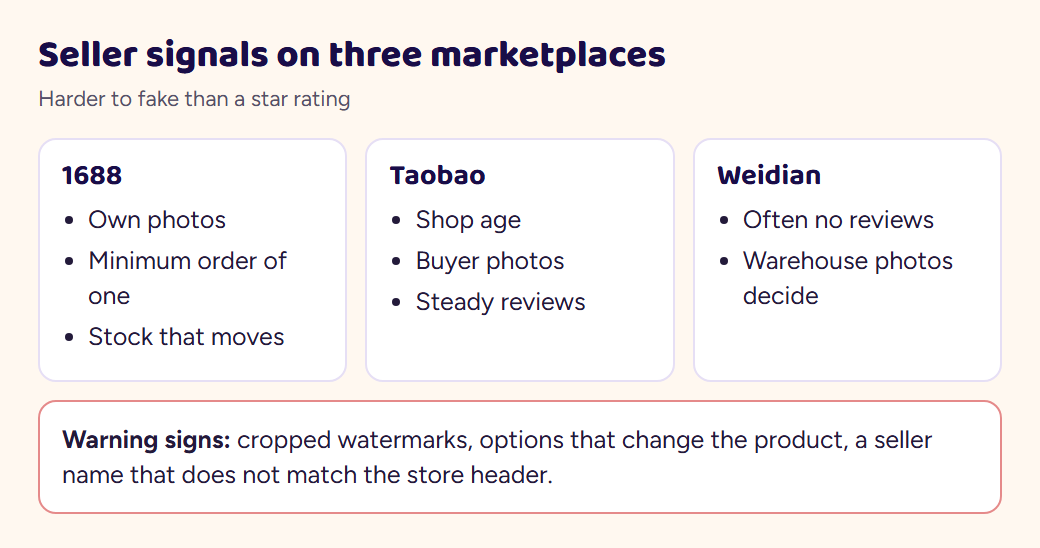
Ratings on 1688, Taobao and Weidian are noisy, so lean on signals that sellers cannot easily dress up. On 1688, a factory store with its own photos, a stated minimum order of one and a stock count that changes over a week is a working seller; ZentBuy's item page shows the stock figure and minimum order beside the quantity box. On Taobao, the shop age and how many items carry real buyer photos say more than the score. Weidian shops often have no reviews at all, which is normal for the platform and means the warehouse photos carry all the weight.
Warning signs repeat across all three: photos lifted from another shop with the watermark cropped, a specification menu that changes the product rather than the colour, and a seller name that does not match the store header. ZentBuy's item page shows the store name in Chinese above the title, with an Enter Store button that lets you see what else that seller lists.
Weighing ZentBuy's paperwork like any agent's
How to judge an agent, ZentBuy included, is mostly about reading what it writes about itself and checking that the pieces agree. For ZentBuy we found three places where they do not: five company names across the footer, the terms and the privacy policy; a free service on the fee page against an 8 percent clause in the registration agreement; and storage wording that varies between 90 days to abandonment and 120 days with fees. None of that is proof of bad faith, since white-label platforms reuse contract text, but it tells you to keep screenshots of every price you pay.
The things worth checking at any agent: whether a freight estimator works without an account (ZentBuy's does), whether the return window and its fee are written down (five days, 5 yuan), whether delay is compensated (only with paid cover), and what happens to your account during a card dispute (it is locked until the dispute is withdrawn). A trustworthy agent is one whose written rules you can live with when something goes wrong, not one with the best home page.
Telling a careful product catalog from a lazy one
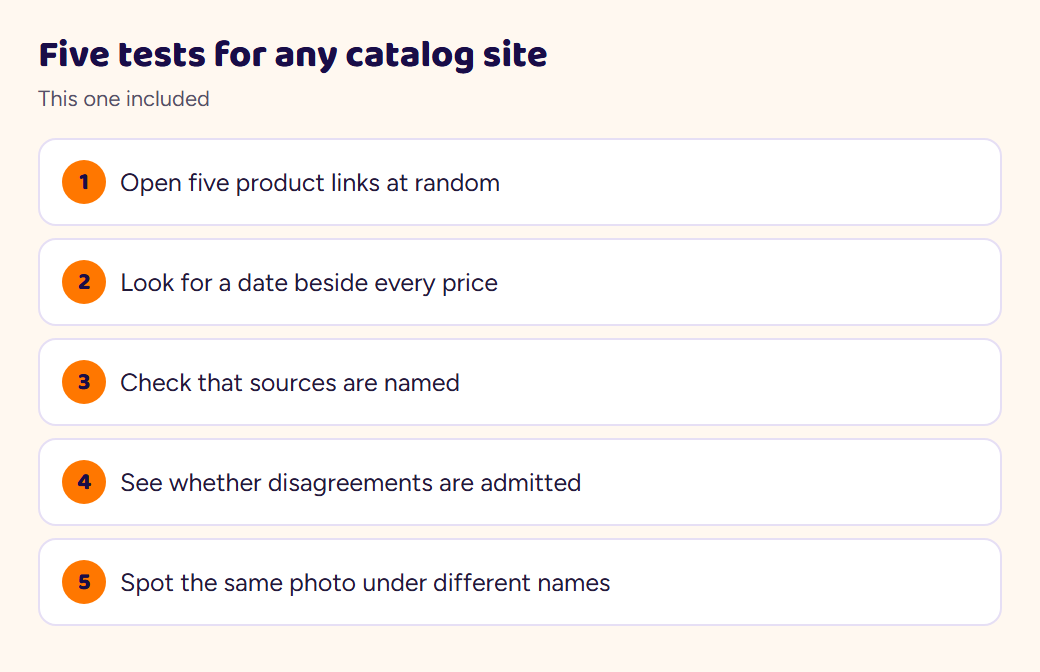
How to judge a spreadsheet site before trusting its picks: open five product links at random. If one is dead, the list is not maintained. Look for dates beside prices; a price without a date is a guess. Check whether the site says where its facts come from and whether it admits when official pages disagree. And look at the images: catalogs that recycle the same seller photo under three different names were not built by anyone who opened the listings.
Apply the same test here. Each pick on this site shows the listing price with the date we read it, every fact about ZentBuy carries the date of the page it came from, and dead links can be reported to the address in the footer. If you find a pick whose photo does not match its listing, tell us and it comes off the shelf.
Costly slips: knives, cut tags, day ninety-one
- Buying what cannot fly. Knives of every kind, lighters, seeds, juice and cheese are on ZentBuy's restricted list, and liquids, creams, powders, cosmetics and medicine should be cleared with support first. Batteries and magnets shrink the list of lines that will take a parcel.
- Cutting the tags to try it on. Clothes with tags removed lose the return option, and photos cannot show fit anyway.
- Letting storage run. Day 91 starts the overdue fee, and other official pages talk about abandonment after 90 days.
- Packing ten of one thing. Many copies of one item, or a parcel over 10 kg, look commercial to customs.
- Disputing a charge first. A PayPal or card chargeback locks the ZentBuy account, which freezes every order and refund until it is withdrawn.
- Reading the tile instead of the listing. Search tiles are translations; the specification menu decides what is bought.
Branded goods and ZentBuy's own policy on them
ZentBuy's Anti-Counterfeiting Policy declares strict opposition to counterfeits and to intellectual property infringement, and that it may review orders, ask for proof of authenticity, cancel orders and suspend accounts. The item page repeats a disclaimer that items come from third-party platforms and that ZentBuy cannot verify quality or authenticity. Our catalog avoids the problem from the other side: we only pick unbranded listings, and we skip any listing whose title, photos or options lean on a brand name.